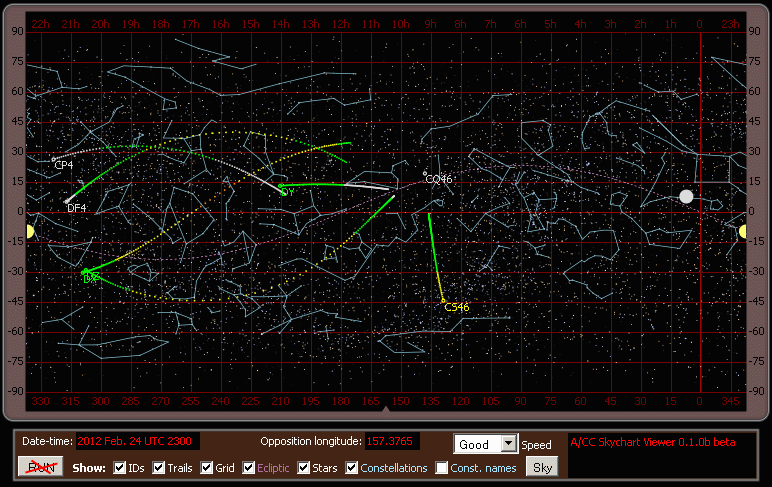
"Opposition longitude" (in degrees) is exactly opposite to the direction to the Sun through Earth's center. Asteroids in this region -- near the ecliptic plane and outside Earth's orbit -- are at their brightest as seen from Earth and thus most likely to be discovered and followed. As objects come and go, they appear on the chart only when approaching or passing through our ten-LD reporting "bubble." To show here, they must be known (recently discovered or returning from a previous Earth passage), and they must be either inside the bubble (colored objects) or less than 20 LD out on approach (white). Our previous version of this skychart showed close-passing objects at all distances, well beyond 20 LD and after leaving the bubble, thus accumulating considerable clutter.
Skychart frame rate seems smoothest at the "good" speed setting, but your experience may differ. Single-clicking anywhere on the skychart acts like hitting the [Run/Stop] button.
This Asteroid/Comet Connection (A/CC) animated illustration runs in basic HTML5 and Javascript using data from NASA/JPL Horizons (see credits) and the Bright Star Catalog, with star colors per Mitchell Charity. We welcome feedback.
Footnotes

1. Ten lunar distances: One "lunar distance" (LD) is the average distance between Earth and Moon (about 384,400 km., the same as 238,855 miles or 9.59 times around Earth's equator). Ten lunar distances has no special astronomical importance but is a useful giant traveling "bubble" within which to organize this special reporting. The approach of a small Solar-System body becomes more interesting when it comes closer than 2.41 LD, as it encounters our planet's gravitational sphere of influence (SOI). Earth's gravity can change the orbits of objects passing through its SOI. The Moon also has its own SOI, which changes as its distance from Earth varies, but never extends much more than 0.18 LD. (The simple illustration above, with Earth and Moon not to scale, shows Earth's SOI as a dotted vertical blue line.) The "Earth-Moon system" is generally defined as that region of space within a radius of one lunar distance from Earth, so an object can pass quite close to the Moon yet not be described as coming "inside" the E-M system.
2. Data credit: All data used to generate this and related pages comes from the NASA JPL Solar System Dynamics (SSD) Group through its Horizons system. All observer credits come from the IAU Minor Planet Center (MPC) and info about radar observations comes from JPL SSD. The MPC, NASA, and JPL are not associated with this page or A/CC, and responsibility for the interpretation of this information and its use here rests entirely with A/CC.
3. Skychart further notes: For illustration, the Sun and Moon are shown out of proportion to the background sky, each depicted as five degrees in apparent diameter instead of about a half degree actual. All asteroids tracked optically from Earth are seen as single points of light without apparent diameter.
4. Skychart known issues:
- -- none --
- Please report problems. See here what the animated skychart should look like. If you are not getting something similar with Javascript enabled in an HTML5-capable browser, please send a screen shot (in Windows, use [Alt]-[PrtScr] to copy to memory, open an image editor (such as Paint or Paint 3D in Windows 10, at Start/Paint 3D or Start/Windows Accessories/Paint), then paste and save as a JPEG).